Last updated June 24, 2026
Garage Door Repair Maintenance Checklist for Medina Homeowners
After nearly two decades of service calls across Medina, one pattern stands out above every other: the overwhelming majority of emergency repairs weren’t sudden failures — they were slow-developing problems that a 15-minute walk-around would have caught months earlier. Springs don’t snap without warning. Cables don’t fray overnight. Rollers don’t seize out of nowhere. They signal, quietly, before they fail — and most homeowners miss those signals because nobody ever showed them what to look for. This guide changes that. What follows is the actual inspection framework Edward Jacobson uses on every maintenance visit in Medina, organized by what’s most likely to hurt you — or your wallet — if you ignore it.
Quick Answer
A complete garage door maintenance checklist for Medina homeowners covers seven core inspection points: springs, cables, rollers, tracks, hardware fasteners, weatherstripping, and opener safety systems. Checking these components twice a year — ideally in October before Ohio’s hard freezes and again in March after the thaw — prevents the vast majority of breakdowns. Most of the visual checks take under 15 minutes and require no tools or contact with high-tension components.
Table of Contents
- The Seven Inspection Points That Predict 90% of Breakdowns
- Which Lubricants Actually Work on Ohio-Exposed Hardware
- The Safe Ground-Level Cable and Spring Visual Check
- Seasonal Timing: What to Check in October and March in Medina
- How to Test Auto-Reverse and Force Sensitivity Properly
- Opener and Wall Control Inspection
- Common Mistakes to Avoid
- When to Call a Professional
The Seven Inspection Points That Predict 90% of Breakdowns
These seven points are ordered by severity — meaning how dangerous or costly the failure becomes the longer it goes unaddressed. Start at the top of this list every time you do a walk-around.
- Torsion or extension springs. Springs are under extreme tension and are the single most dangerous component on your door. A visual check from ground level — without touching anything — is enough to spot rust, gaps in the coil winding, or a full break. In Medina’s climate, we see spring corrosion accelerate after back-to-back winters with road salt blown into garage interiors from Weymouth Road and Pearl Road-area homes with attached garages facing north or west. A broken spring means the door’s weight is no longer counterbalanced — forcing the opener motor to compensate until it burns out.
- Lift cables. Cables run alongside the door’s vertical tracks and support the door’s weight when the springs do their job. Look for fraying, kinking, or slack on either side. Uneven cable wear almost always means something else is misaligned — a roller out of its track, a bent track section, or a spring that’s lost tension on one side.
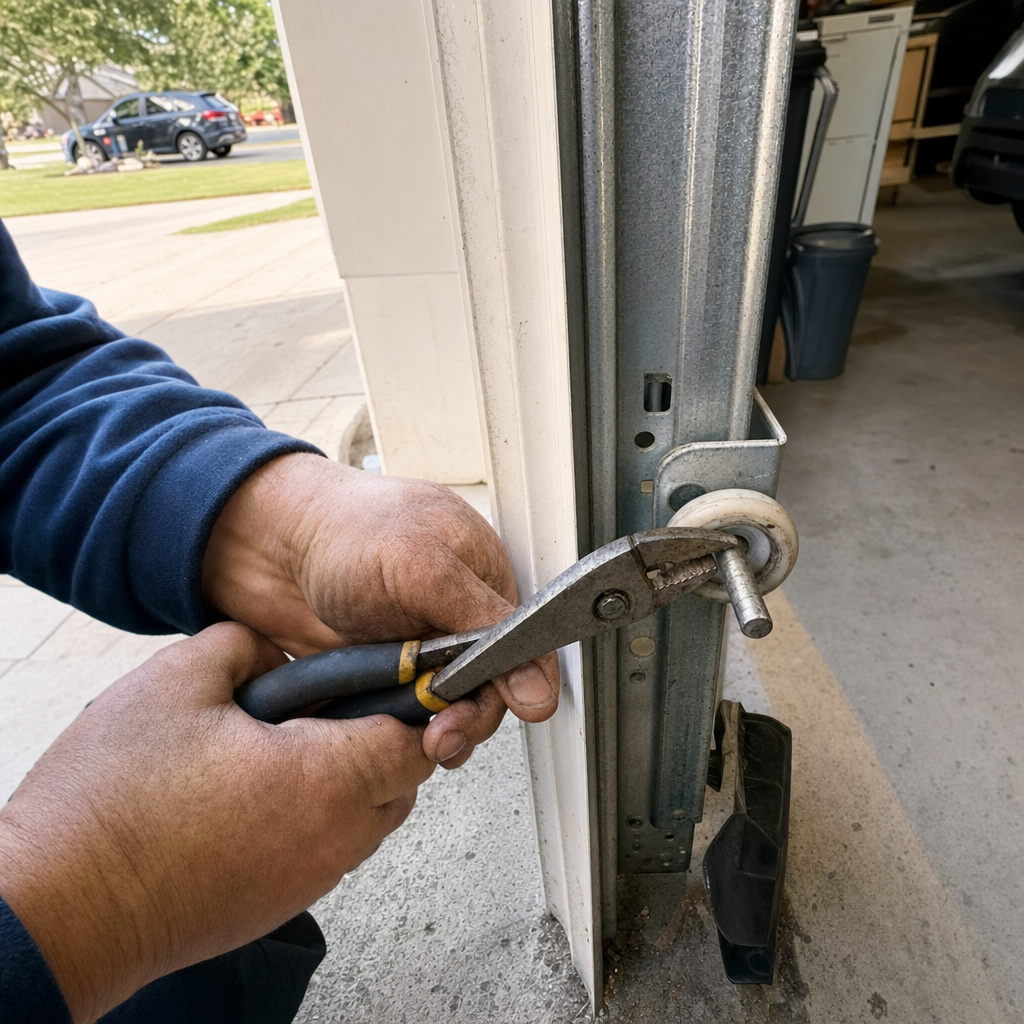
- Rollers. Steel rollers without nylon sleeves are the first thing to go in a garage that runs 4–8 cycles per day. Look for flat spots, chips, or rollers that wobble in their brackets. Nylon-on-steel rollers — the kind found on most Clopay and Amarr doors — last longer but still need inspection every 12 months.
- Tracks. Run your hand lightly along both vertical tracks (door fully closed) and check for dents, bends, or gaps at the bracket connections. Even a small dent on a Craftsman or Wayne Dalton door’s track will create a resistance point that eventually stalls the opener.
- Hardware fasteners. Hinges, roller brackets, and track mounting bolts vibrate loose over thousands of cycles. A door that rattles on the way down isn’t a minor annoyance — it’s a loosening hardware set waiting to cause a track-jump.
- Weatherstripping. The bottom seal and side seals keep Medina’s winter air, water, and pests out of your garage. Cracked or missing weatherstripping also allows moisture under the door, which accelerates rust on the bottom panel and the concrete threshold below it.
- Opener safety sensors. The photo-eye sensors mounted near the floor on each side of the door need to be aligned, clean, and unobstructed. In Medina homes with finished garages, we frequently find sensors knocked out of alignment by brooms, bikes, or storage bins — a condition that causes the door to reverse or refuse to close entirely.
Which Lubricants Actually Work on Ohio-Exposed Hardware
This is the section most maintenance guides get wrong — either because the writer has never worked a winter in northeast Ohio, or because they’re repeating advice designed for mild climates.
Use this: White lithium grease or a dedicated garage door lubricant (the LiftMaster 50ml lubricant or equivalent) on springs, hinges, roller stems, and lock mechanisms. White lithium grease stays viscous in cold temperatures and doesn’t fling off onto panels the way spray lubricants do.
Don’t use this: WD-40. It’s a water displacer, not a long-term lubricant. It evaporates quickly, leaves a residue that attracts fine grit, and in Medina’s freeze-thaw cycle, that grit-residue combination accelerates wear on roller stems and hinge pins faster than no lubrication at all. We’ve seen this pattern repeatedly on service calls in the Litchfield and Lafayette Township corridors where garages are more exposed to field dust in summer and road grit in winter.
What NOT to lubricate:
- Tracks — the rollers need to roll freely, and lubricating tracks makes them tacky, attracting debris.
- Plastic components — nylon rollers, plastic chain guides on Chamberlain and Genie belt-drive openers, and plastic idler pulleys do not need lubrication and can be degraded by petroleum-based products.
- The bottom seal — it’s rubber and needs to remain flexible, not coated.
Apply lubricant with the door open, work it into each hinge and roller stem, then cycle the door three or four times to distribute it. Wipe any excess off the panel faces before it drips or stains.
The Safe Ground-Level Cable and Spring Visual Check
You do not need to touch springs or cables to evaluate their condition. In fact, you should never manually adjust, unhook, or attempt to repair springs or cables yourself — torsion springs store enough energy to cause serious injury in a failure event. What you can do safely, from ground level, in under five minutes:
- Stand inside the garage with the door fully closed. Look up at the torsion spring(s) above the door opening. The spring should be continuous coil — if you see a gap anywhere in the winding, the spring is broken and the door should not be operated until it’s replaced.
- Check for visible rust on the spring coils. Light surface rust is common after a wet Ohio winter. Heavy rust — where the coil surface looks pitted or flaking — means the spring’s fatigue life has shortened significantly. On a door that’s 8–12 years old, that’s a replacement conversation.
- Look at both lift cables along the vertical tracks. They should be taut, parallel to the track, and seated in the bottom fixture drum. Slack on one side, or a cable that’s jumped its drum, means the door is running unevenly and will bind or jam under load.
- Do the balance test. Disconnect the opener (pull the red emergency release cord), then manually lift the door to waist height and let go. A properly balanced door will stay in place or drift very slowly. A door that drops quickly or rockets upward has a spring tension problem — and that imbalance is hammering your opener motor every single cycle.
If anything in this check looks wrong, stop operating the door and call for service. Running an unbalanced door or a cable that’s jumped its drum turns a $200 repair into a $600 repair with remarkable speed.
Seasonal Timing: What to Check in October and March in Medina
Medina sits in northeast Ohio’s freeze-thaw belt, and your garage door maintenance schedule should reflect that reality — not a generic “check twice a year” recommendation that was written for Phoenix or Atlanta.
October Pre-Winter Check
- Lubricate all moving parts before temperatures drop below 20°F. Cold thickens grease and dries out unoiled metal — a door that ran fine in September will run rough in January if you skip this step.
- Inspect the bottom weatherseal. If it’s cracked, compressed flat, or missing chunks, replace it before the first hard freeze. A failed bottom seal lets cold air and moisture into the garage, and in homes with finished garages in Medina’s Guilford Township or Montville Township areas, that moisture contributes to drywall and insulation damage over time.
- Test the opener’s force settings. Cold temperatures make door components stiffer, and an opener calibrated for summer conditions may not have enough force to lift a door in January without straining. We’ll cover how to adjust this properly in the next section.
- Check for wood panel swelling on wood or wood-composite doors — particularly older Wayne Dalton or custom wood doors. Wood expands as humidity rises in fall, and a door that fit perfectly in August may bind in the tracks by November.
March Post-Thaw Check
- Re-inspect all hardware fasteners. The expansion and contraction cycle of a Medina winter — with temperatures swinging 40 or 50 degrees between January lows and March highs — works fasteners loose reliably. Go through every visible bolt and hinge screw.
- Clean the tracks. Winter brings road salt, sand, and grit into the garage on every vehicle. That material collects in the vertical tracks and creates friction points for rollers. Wipe tracks clean with a dry rag before re-lubricating any components.
- Check the spring for winter fatigue. Springs that made it through fall in decent shape sometimes show new rust, cracking, or coil gaps after a hard Ohio winter. March is when we catch the springs that won’t survive another season.
- Test sensor alignment. Frost heave can subtly shift the concrete near the sensor brackets, throwing photo-eye alignment off just enough to cause intermittent close failures.
How to Test Auto-Reverse and Force Sensitivity Properly
Most guides tell you to put a 2×4 flat on the ground and close the door — if it reverses, you’re good. That test checks one thing: the mechanical auto-reverse trigger. It doesn’t tell you whether your door’s force sensitivity is properly calibrated, or whether your photo-eye sensors are actually functioning within spec. Here’s a complete test sequence:
- Photo-eye obstruction test. Close the door. While it’s in motion, wave your leg or arm through the sensor beam path (not your hand — keep fingers away from moving hardware). The door should immediately stop and reverse. If it doesn’t stop, the sensors are misaligned, blocked, or faulty.
- Photo-eye alignment check. Look at the sensor indicator lights. On LiftMaster and Chamberlain openers, a steady green on the receiving sensor and a steady amber on the sending sensor means proper alignment. A blinking or absent green light means misalignment — usually fixable by loosening the sensor mounting wing nut, adjusting by hand, and retightening.
- Mechanical reverse test (the board test, done right). Place a 2×4 flat on the ground — not on edge — centered under the door. Close the door using the wall button or remote. When the door contacts the board, it should reverse within two seconds of contact. If it grinds down on the board before reversing, or doesn’t reverse at all, the down-force sensitivity needs adjustment.
- Up-force sensitivity test. With the door fully closed, grab the bottom of the door with both hands and try to push it upward while pressing the open button. If the opener motor overpowers your upward resistance easily and the door continues moving up, the up-force is within normal range. If the door stops when you apply light resistance, the up-force setting may be too low and the opener needs recalibration.
- Manual disconnect test. Pull the red emergency release cord to disconnect the trolley. Open and close the door manually. It should move smoothly with moderate effort — no heavy pulling, no sudden drops. Any binding or heaviness with manual operation means there’s a mechanical problem the opener has been masking.
On Genie, Raynor-compatible, and older Craftsman openers, force adjustment is typically a pair of small dials on the motor head labeled “Up Force” and “Down Force.” On newer LiftMaster 8500W series and Chamberlain smart openers, force calibration is done through the app or the learn button sequence. If you’re not sure which model you have, call us — Edward can usually diagnose the opener series from a description or a photo.
Opener and Wall Control Inspection
The opener is the most electronically complex part of your garage door system and the one most homeowners ignore until it stops working entirely. A quick annual inspection takes less than 10 minutes.
What to Check on the Opener Unit
- Drive system. Chain-drive openers (common on older Craftsman and Genie units) should have slight chain slack — about half an inch of droop at the midpoint. Too tight causes premature motor wear; too loose causes the chain to slap the rail and skip. Belt-drive systems on LiftMaster and Chamberlain units should have no visible slack.
- Motor heat. After a few cycles, the motor housing should be warm, not hot. An overheating motor typically means the door is too heavy for the opener rating, or there’s a mechanical resistance problem — both conditions cause premature motor failure.
- Lights and indicators. Check that the opener light bulbs are rated for vibration — standard incandescent bulbs loosen and fail quickly in opener housings. LED bulbs designed for garage door openers (check the LiftMaster 41A5034 replacement spec or equivalent) are more durable.
Wall Control and Remote Check
- Test every remote and keypad — replace batteries annually, not just when they fail.
- On smart openers (LiftMaster myQ, Chamberlain myQ), verify the Wi-Fi connection is active and the app shows correct door status. A dropped myQ connection is one of the most common service call drivers we see in Medina homes where the router is on the opposite end of the house from the garage.
- Test the wall button’s lock function, if equipped — this disables all remotes and keypads and is easy to activate accidentally, causing apparent “remote failure.”
Common Mistakes to Avoid
- Lubricating the tracks instead of the rollers. This is the most common DIY maintenance mistake we see on service calls across Medina. Greasy tracks attract grit, create uneven resistance, and cause rollers to slide instead of roll — which wears out both the roller and the track surface faster than leaving them dry.
- Ignoring one-sided cable slack. A cable that’s jumped its drum on one side looks like a minor alignment issue. Left alone, it causes the door to rack — twist in the frame — which bends tracks, strips trolley carriages, and eventually damages the door panels themselves. In Medina homes with 16-foot wide two-car doors, a racked door can cause panel separation along the horizontal joint.
- Using WD-40 as a lubricant. As covered above, WD-40 is a cleaner and water displacer, not a long-term lubricant. It accelerates wear on unoiled surfaces after it evaporates and leaves behind a grit-attracting residue.
- Skipping the balance test after spring replacement. A newly installed spring should be tensioned precisely for the door’s weight. We’ve seen homeowners have springs replaced by non-specialists who eyeball the tension, resulting in doors that are 15–20 lbs out of balance. That imbalance strains the opener every single cycle and cuts motor life significantly.
- Running the door on a broken spring “just for now.” When a torsion spring breaks, the opener is lifting the full unbalanced weight of the door — often 150 to 200 lbs for a steel door. Running the opener in this condition can burn out the motor within days. We’ve replaced openers on Medina homes that were only three years old because the homeowner ran them on a broken spring for two weeks.
- Replacing only one spring when two are installed. Two-spring systems are designed to work as a matched pair with equal tension and fatigue life. When one breaks, the other is typically at the same wear point. Replacing only the broken spring means the other fails within months — and you pay for two service calls instead of one.
- Ignoring the door’s bottom weatherseal until it’s completely gone. A deteriorating seal doesn’t just let cold air in — it allows moisture under the door that rusts out the bottom panel from the inside, which is one of the most expensive panel repairs on steel doors from Clopay, Amarr, and Wayne Dalton.
When to Call a Professional
Some of this checklist is genuinely DIY-friendly. The rest is not, and knowing the line matters for your safety and your budget.
Call a professional immediately if you see:
- Any gap, break, or visible crack in a torsion or extension spring
- A lift cable that has jumped its drum, gone slack on one side, or is visibly fraying
- A door that drops faster than normal under manual operation, or won’t stay at mid-height
- The opener running but the door not moving — a broken spring the motor can’t overcome
- The door reversing mid-travel for no apparent reason — sensor misalignment or force calibration issue
- Any grinding, metal-on-metal sound during operation — roller or track damage that’s getting worse with every cycle
At Garage Door Repair in Medina, Titan Garage Door Solutions provides free estimates — call (888) 784-7992 and Edward will give you a straight answer on what needs fixing, what can wait, and what it’s going to cost before any work starts.
Frequently Asked Questions
Lubricate your garage door’s springs, hinges, rollers, and lock mechanism twice a year — once in October before the first hard freeze and once in March after the thaw. Medina’s freeze-thaw cycle is harder on metal hardware than in milder climates, so the twice-yearly schedule matters more here than in a region with consistent temperatures. Use white lithium grease or a dedicated garage door lubricant — not WD-40. Call (888) 784-7992 if you’d like a professional lubrication and inspection done at the same time.
A spring that’s approaching failure typically shows visible rust on the coil surface, a stretched or uneven winding pattern, or a slight gap forming in the coils. The balance test is also a reliable early indicator — if your door drops quickly when you disconnect the opener and release it at mid-height, spring tension has degraded. In Medina, most residential torsion springs have a 10,000-cycle rated life, which translates to roughly 7–10 years at average use. If your springs are in that age range and showing rust, it’s worth a professional assessment before they fail. Call (888) 784-7992 for a free estimate.
Visual inspections, lubrication, sensor alignment, weatherseal replacement, and tightening loose hardware are all reasonable DIY tasks that this checklist covers. Spring work, cable repair, track realignment, and opener force calibration require a trained technician — not because they’re mechanically complex, but because the consequences of getting them wrong (or getting near a failed spring) are serious. The line is simple: if it involves touching the springs or cables under tension, call a professional.
White lithium grease is the most effective lubricant for Medina’s climate — it stays viscous in cold temperatures and doesn’t fling off onto door panels. Dedicated garage door lubricants, like the product LiftMaster packages for their systems, are also excellent. Avoid WD-40, standard machine oil, and grease products not rated for temperature swings, as they either evaporate too quickly or thicken and resist movement in cold weather.
A professional garage door tune-up in the Medina market typically runs between $80 and $150, depending on the scope of work — lubrication, hardware tightening, balance adjustment, safety sensor test, and opener calibration are usually included. If the technician finds worn rollers, a failing weatherseal, or a spring at end-of-life during the tune-up, those repairs are quoted separately before any work begins. Call (888) 784-7992 for a free estimate — Edward will walk you through exactly what your door needs before any tools come out.
Yes — Edward Jacobson is factory-familiar with LiftMaster, Chamberlain, Genie, Clopay, Amarr, Wayne Dalton, Craftsman, and Raynor. Those eight brands cover virtually every residential garage door and opener combination you’ll find in Medina. Whether you have a Clopay steel door with a LiftMaster belt-drive opener or a Wayne Dalton Torquemaster system, the diagnosis and repair process is the same: accurate the first time, explained clearly, with upfront pricing before the work starts. You can learn more about our full range of services at Titan Garage Door Solutions Medina home.
The Bottom Line
A garage door that fails doesn’t usually fail without warning — it warns you with rust, slack cables, noisy rollers, and a balance test that feels slightly off. Catching those signals on a 15-minute twice-yearly walk-around prevents the $400 emergency call, protects your opener from burning out under an unbalanced door, and keeps your home secure. Use October and March as your fixed inspection dates in Medina. Follow the lubrication guidelines, run the five-step safety system test, and know which repairs stay in your hands and which ones call for Edward. After nearly two decades and 346 five-star reviews, the pattern is clear: maintained doors don’t become emergencies. Explore professional Garage Door Installation in Medina or Garage Door Opener in Medina services if your inspection reveals it’s time for an upgrade rather than another repair cycle.
Written by Edward Jacobson, Owner & Lead Technician at Titan Garage Door Solutions Medina, serving Medina since 2007.