Last updated June 24, 2026
The Complete Guide to Garage Door in Medina
Your garage door has more moving parts than most homeowners ever think about — and that gap between what you own and what you understand is exactly where expensive mistakes get made. In Medina, where winter temperatures swing hard enough to contract metal, crack seals, and snap springs that were already stressed from years of daily cycling, that knowledge gap costs real money. This guide gives you the working knowledge of a technician: what every major component does, how Medina’s climate specifically attacks your system, when a repair makes sense versus when replacement math wins, and how to read the warning signs your door is already broadcasting before you end up standing in a half-open garage at 7 a.m. in January.
Quick Answer
A garage door system in Medina, OH consists of the door panels, torsion or extension springs, cables, rollers, tracks, hinges, weatherseals, and an opener — all of which must work together to lift and lower safely. Most failures are predictable and repairable if caught early, but Medina’s freeze-thaw cycle accelerates wear on springs, cables, and bottom seals faster than the national average. Understanding how the system works as a whole — rather than treating each symptom as an isolated emergency — is the single best way to make smarter, less expensive decisions about your door.
Table of Contents
- How a Garage Door System Actually Works
- How Medina’s Freeze-Thaw Cycle Attacks Your Garage Door
- Component Failure Hierarchy: What Breaks First and Costs the Most
- How to Read Your Door’s Signals Before Calling Anyone
- Repair vs. Replace: Where the Math Actually Breaks
- What Owner-Operated Service Actually Means in a Market Like Medina
- Common Mistakes to Avoid
- When to Call a Professional
How a Garage Door System Actually Works
Most homeowners think of a garage door as a single thing — a big panel that goes up and goes down. In practice, it’s a mechanical system with a dozen interdependent components, and when one fails, the rest compensate in ways that accelerate their own wear. Understanding the parts is the first step to understanding the costs.
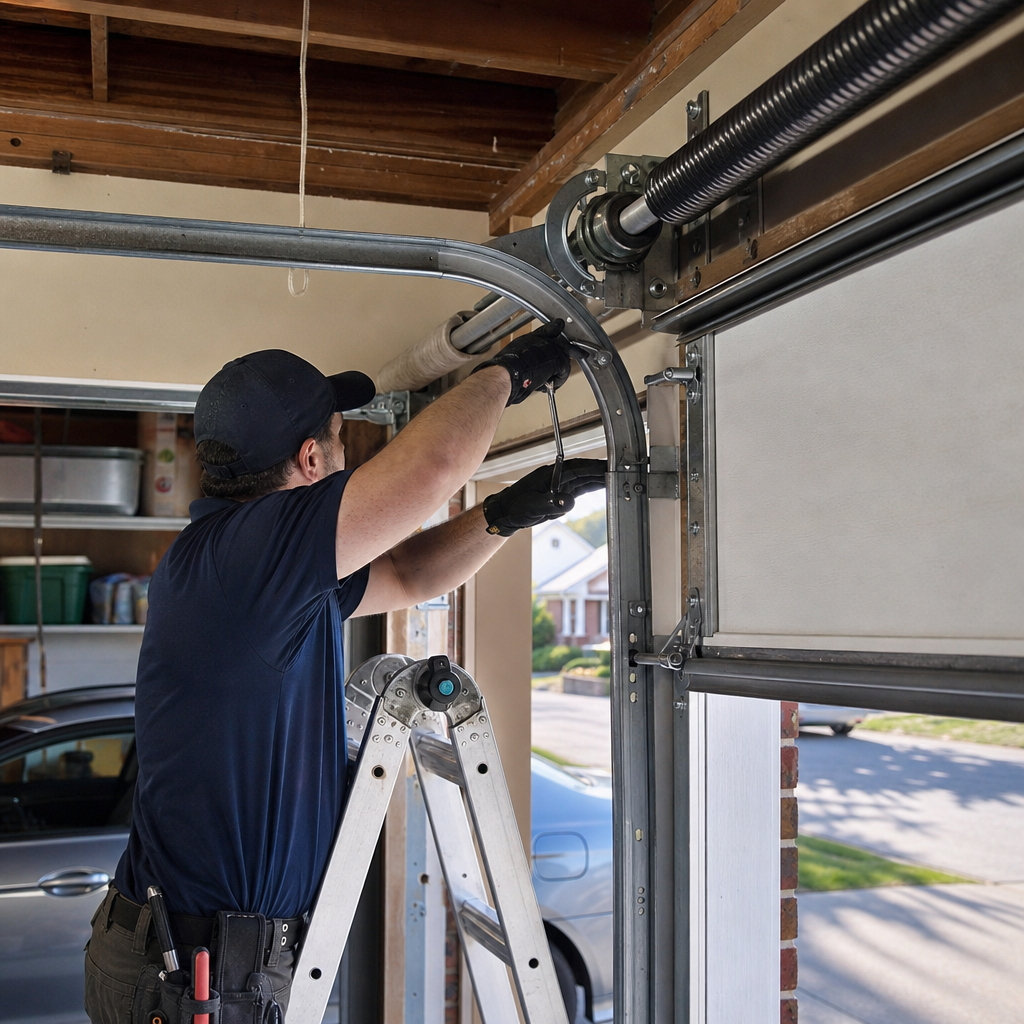
Here’s what makes up a complete residential garage door system:
- Door panels: The visible face of the door, usually steel, wood, composite, or fiberglass. Panels can dent, crack, or warp, and a damaged bottom section can compromise the entire seal.
- Torsion springs: Mounted horizontally above the door opening, these store and release mechanical energy to counterbalance the door’s weight. One broken spring renders most doors inoperable.
- Extension springs: Used on lighter doors, these stretch alongside the horizontal tracks. Less powerful than torsion springs, but still under significant tension.
- Cables: Steel cables run from the bottom corners of the door up to the spring drum. They transfer spring energy into lift. A frayed or snapped cable can cause a door to drop asymmetrically — and dangerously.
- Tracks and rollers: The vertical and horizontal tracks guide the door through its arc. Rollers (typically nylon or steel) must move freely; worn rollers create the grinding noise most people ignore for too long.
- Hinges: Sectional doors use multiple hinges between panels. When hinges fail, panels crack at the connection points.
- Bottom seal and weatherstripping: Rubber or vinyl seals along the bottom and sides keep out water, wind, and pests. In Medina, these are the first components to harden and crack in cold weather.
- Garage door opener: The motorized drive unit — chain, belt, screw, or direct drive — that automates the lift cycle. Openers from LiftMaster, Chamberlain, Genie, Craftsman, and Raynor each have distinct diagnostic behaviors worth knowing.
These components don’t fail independently. A spring under extra tension because the door is out of balance puts extra load on the cables. Worn rollers create track friction that makes the opener motor work harder, shortening its lifespan. That’s why the cheapest repair isn’t always the most targeted repair — sometimes addressing root cause is what prevents the next service call.
How Medina’s Freeze-Thaw Cycle Attacks Your Garage Door
Medina sits in a climate zone where temperatures routinely swing from the single digits in January to the 80s in July, and where February thaws followed by re-freezes are common. That thermal cycling is harder on garage door components than either a consistently cold or consistently mild climate. Here’s exactly what happens:
Springs
Steel torsion and extension springs become more brittle as temperatures drop. A spring that’s already at 70–80% of its fatigue life may survive a mild winter in a southern state — in Medina, that same spring often doesn’t make it to March. We see a predictable spike in spring failures during the first hard cold snap of the season, typically November, and again after a February thaw when metal contracts sharply overnight. If your springs are more than 7–8 years old and you haven’t had them inspected, they’re already in that danger zone.
Cables
The steel cable strands that run along the door’s sides absorb moisture during Medina’s wet winters. That moisture accelerates oxidation and, in the freeze-thaw cycle, works its way between cable strands and contributes to fraying. A cable that looks intact in September may be down to half its working strands by February.
Bottom Seals
Rubber and vinyl bottom seals become rigid in sustained cold and then soften again in thaw cycles. That repeated hardening and softening degrades elasticity faster than almost any other stress factor. In older homes around Medina’s Weymouth Road corridor and near the Guilford Township edge, where garages often face northwest and take the full force of Lake Erie-fed wind, this wear happens even faster. A failed bottom seal lets in water that then freezes on the floor and can freeze the door itself to the threshold — a common source of opener motor burnout when a homeowner presses the button without realizing the door is frozen in place.
Weatherstripping and Panel Joints
The side and top weatherstripping compresses and releases with every door cycle. Cold temperatures cause these rubber strips to shrink and pull away from the frame, creating gaps that let in wind-driven rain and cold air. In panel-joint areas, water infiltration followed by freezing can cause panel steel to pit and rust from the inside out — damage that often isn’t visible until a panel section is already compromised.
Component Failure Hierarchy: What Breaks First and Costs the Most
Based on nearly two decades of garage door work in Medina and the surrounding area, here’s how component failures rank by frequency and by typical repair cost. This hierarchy is what Edward uses as a diagnostic priority framework — knowing it helps you understand why certain repairs get recommended first.
- Springs (Most Common Failure): Torsion springs carry the full weight of the door every cycle. A typical residential torsion spring has a rated cycle life of 10,000 cycles — roughly 7–10 years at average use. Replacement typically runs $180–$320 for a standard double-door setup in the Medina market, depending on spring size and whether one or both are replaced. Always replace both simultaneously; if one has broken, the other is usually within months of failing.
- Rollers: Nylon rollers wear out before steel ones but run quieter until they fail. Replacement is relatively inexpensive ($95–$175 for a full set), but ignored worn rollers cause track damage that is not inexpensive.
- Bottom Seals and Weatherstripping: Low parts cost ($40–$90 for most doors) but frequently skipped until visible water infiltration or a door freeze-down makes the problem undeniable. In Medina, this is a annual inspection item.
- Cables: Cable replacement is typically bundled with spring replacement because the labor overlap makes it cost-effective. Standalone cable repair runs $120–$220 depending on extent of damage.
- Garage Door Openers: Openers have a typical lifespan of 10–15 years. LiftMaster and Chamberlain units tend to have the most robust parts availability; older Craftsman and Raynor units can become parts-constrained. Opener replacement in the Medina market typically runs $280–$550 installed, depending on drive type and features.
- Panels: Single dented or cracked panels can sometimes be replaced individually ($150–$300 per section) if the manufacturer still produces matching panels. For doors over 12 years old, matching panels is often impossible, which moves the conversation toward full replacement.
- Tracks: Tracks rarely fail on their own but can be bent by vehicle impact or severe cable/roller failure. Bent track repair or replacement: $125–$250 depending on damage scope.
How to Read Your Door’s Signals Before Calling Anyone
Your garage door communicates its condition through noise, speed, and movement. Most homeowners have been habituating to a gradually worsening door for months before a failure. Here’s how to do a basic self-assessment:
The Balance Test
- Disconnect the opener by pulling the red emergency release cord.
- Manually lift the door to waist height and let go.
- A properly balanced door stays in place — or drifts very slowly. A door that drops quickly or shoots up has spring tension out of balance.
- Do not attempt to adjust spring tension yourself. Torsion springs under load are capable of causing serious injury.
The Noise Diagnostic
- Grinding or scraping: Usually rollers or track debris. Inspect rollers for flat spots or cracked nylon.
- Popping or banging on the way up: Spring coil binding or a cable jumping off the drum. Stop using the door and call for service.
- Squealing: Typically metal rollers or hinge pivot points needing lubrication. Use a lithium-based spray, not WD-40, which attracts dirt.
- Rattling: Loose hardware — check hinge bolts and track brackets. A 5-minute tightening pass twice a year prevents track drift.
- Clicking from the opener: Often a logic board relay failing or a limit switch issue — not always a mechanical door problem. Genie and Wayne Dalton openers have specific blink codes worth looking up.
The Visual Check
Stand inside the garage with the door closed. Look at both springs — a gap in the coil means a broken spring. Look at both cables — they should be taut, coiled evenly on the drum, and free of visible fraying near the bottom bracket. Look at the bottom seal — it should compress flat against the floor with no visible gaps at the corners or center.
Repair vs. Replace: Where the Math Actually Breaks
This is the question that generates the most uncertainty for Medina homeowners, and the answer isn’t sentimental — it’s arithmetic.
The general industry threshold is this: if the cost of repairs in a single service visit exceeds 50% of the cost of a comparable new door installed, you’re often better served by replacement. Here’s how that plays out in real numbers:
- A basic steel single-car door installed in Medina typically runs $700–$1,100 complete.
- A double-car steel insulated door installed runs $1,100–$2,000, depending on insulation value, panel style, and whether you’re replacing the opener simultaneously.
- A premium Clopay or Amarr carriage-style door with higher R-value insulation can run $2,200–$3,800 installed — a meaningful investment, but one that also improves curb appeal and energy efficiency for attached garages in Medina’s heating season.
The repair-vs-replace calculus also depends on door age. A 15-year-old door with broken springs, worn rollers, and panel damage is a door that will need a new opener within two years anyway. Spending $600 in repairs on that door often just delays the inevitable replacement by 18 months while adding accumulated repair costs. On the other hand, a 6-year-old door with a single broken spring and an otherwise sound structure is a clear repair candidate — springs are expected to be replaced, and the rest of the system has significant life remaining.
One Medina-specific factor: homes built in the 1980s and early 1990s in neighborhoods like Medina’s Heritage Hills area often have original doors that were built to lower insulation standards. If your garage is attached and conditioned, replacing a low-R-value door with a modern insulated panel — Wayne Dalton and Clopay both make strong options at mid-tier price points — can measurably reduce heating costs, which changes the replacement ROI calculation meaningfully.
For a detailed look at new door options and what installation involves in this market, our Garage Door Installation in Medina page covers that decision in full.
What Owner-Operated Service Actually Means in a Market Like Medina
Medina is a mid-size Ohio market — large enough to attract franchise garage door operations, but not so large that accountability gets lost in a national call center. That distinction matters more than most homeowners realize when something goes wrong.
Franchise and national dispatch models typically work like this: you call a number, a dispatcher assigns whoever is available in your area, and that technician may be a relatively new hire working from a standardized price menu. The company’s accountability to you ends when the invoice is paid. If the repair fails in 60 days, you’re starting over with a new technician who has no context on what was done.
Owner-operated service works differently. When Edward Jacobson comes to your door in Medina, he’s the person who built this business over 19 years — and he’s the person whose name is on every one of those 346 five-star reviews. There’s no dispatcher between the accountability and the work. If something needs a second look, you’re calling the same person who did the first visit. That’s not a marketing claim; it’s just how the business is structured.
Parts quality is the other factor that doesn’t get discussed enough. National dispatch models sometimes use house-brand or secondary-market parts because margin pressure demands it. When Edward services a LiftMaster opener or replaces a Clopay panel section, he’s using parts sourced from the same supply chain as the original manufacturer. After nearly two decades working with all eight major brands — LiftMaster, Chamberlain, Genie, Clopay, Amarr, Wayne Dalton, Craftsman, and Raynor — that familiarity means faster diagnosis and fewer parts mismatches.
For homeowners in Medina evaluating service options, the question isn’t just “who’s cheapest today” — it’s “who’s accountable if this isn’t right.” Owner-operated answers that question definitively.
You can learn more about our full service approach on the Titan Garage Door Solutions Medina home page.
Common Mistakes to Avoid
- Ignoring a grinding or scraping noise until the door stops working. Worn rollers are a $150 fix. The bent tracks they eventually cause are a $300+ fix. In Medina, we see this pattern most often in spring after a winter of deferred maintenance — the noise gets normalized, and then the door comes off track in March.
- Using WD-40 to lubricate springs and rollers. WD-40 is a solvent, not a lubricant. It temporarily quiets the noise while attracting grit that accelerates wear. Use a lithium-based spray lubricant on springs, hinges, and rollers — it stays in place and doesn’t draw debris.
- Replacing only one spring when the other is at the same age. If one torsion spring has broken after 10 years of service, the second spring is at 10 years of service too. Replacing both at the same time costs incrementally more in labor but saves a full service call within months. This is one of the most consistent advice points Edward gives on first-time spring calls.
- Pressing the opener button when the door is frozen to the floor. In Medina winters, water from snowmelt can seep under a worn bottom seal and freeze the door to the threshold. Forcing the opener against a frozen door can burn out the motor within seconds. If the door won’t move in cold weather, check for floor freeze first — a hair dryer or hot water applied to the threshold seal usually frees it safely.
- Buying a replacement door based on price alone without checking insulation values. For attached garages in Medina, insulation R-value directly affects your home’s heating performance. A door rated R-6 versus R-16 makes a measurable difference across a Medina heating season. The price gap between a basic and a well-insulated door is often $200–$400 at installation — which typically pays back within a few heating seasons.
- Attempting to adjust or replace torsion springs without professional training. Torsion springs are wound under hundreds of pounds of stored tension. An improper adjustment or a winding bar slip can release that energy violently. This is the one DIY repair that sends homeowners to emergency rooms. It’s not risk-appropriate for any skill level without specialized training and tools.
- Deferring opener replacement on a door that’s already been upgraded. A new insulated door weighs more than the old single-layer door it replaced. Running a 15-year-old opener on a heavier modern door shortens the opener’s remaining life significantly and creates safety issues if the auto-reverse force settings aren’t recalibrated. If you’ve upgraded the door, have the opener load capacity evaluated at the same time.
When to Call a Professional
Some garage door tasks are genuinely homeowner-appropriate: tightening loose hardware bolts, replacing a dead opener battery, lubricating hinges and rollers, or swapping out weatherstripping on a non-motorized section. Everything else carries real risk or requires diagnostic equipment that isn’t practical for a one-time repair.
Call a professional immediately if:
- A spring has visibly broken — the gap in the coil is unmistakable.
- A cable has snapped or come off the drum.
- The door has dropped suddenly or is hanging asymmetrically.
- The opener runs but the door doesn’t move — this indicates a disconnect or a broken component under load.
- The door reverses immediately after closing, with no obstruction in the sensor path.
- Panels are cracked at hinge points, which indicates structural stress beyond cosmetic damage.
- The door moves slower than normal in cold weather and you notice the opener straining — early sign of a spring losing tension before full failure.
For Garage Door Repair in Medina, Titan Garage Door Solutions offers free estimates — call (888) 784-7992 and Edward will assess the problem directly, without an upsell agenda driven by commission.
Frequently Asked Questions
Most garage door repairs in Medina fall between $120 and $400 depending on what’s failed. Spring replacement — the most common single repair — typically runs $180–$320 for a double-door torsion spring setup. Opener repairs run $95–$250 depending on whether it’s a board replacement or a full unit swap. Cable repairs typically run $120–$220. For an exact number on your specific door, call (888) 784-7992 — estimates are free and Edward gives you the diagnosis before any work begins.
Standard residential torsion springs are rated for approximately 10,000 cycles, which translates to roughly 7–10 years at average use. In Medina, the freeze-thaw cycle accelerates metal fatigue, so springs on the lower end of that range are more common here than in milder climates. If your springs are 8 or more years old and haven’t been inspected, consider a professional assessment before winter — a proactive replacement is always cheaper than an emergency call at 6 a.m. in January.
No — and you shouldn’t try. A broken torsion spring means the door’s full weight is no longer counterbalanced. Forcing the opener to lift that load can burn out the motor, snap the cables, or cause the door to drop suddenly. Manually moving the door in this state is also a serious injury risk. Disconnect the opener, leave the door in place, and call for service before operating it again.
The general threshold is: if a single repair visit costs more than 50% of a comparable new door installed, replacement math usually wins. In Medina, a new steel double-car door installed runs roughly $1,100–$2,000 depending on insulation and style. If you’re looking at a $700 repair on a 16-year-old door with worn panels and marginal hardware, a full replacement is likely the better investment — especially given the energy efficiency gains from a modern insulated door in a Medina winter. For a more detailed look at new door options, visit our Garage Door Installation in Medina page.
Edward is trained and experienced on all major residential opener brands: LiftMaster, Chamberlain, Genie, Craftsman, and Raynor, along with door brands Clopay, Amarr, and Wayne Dalton. Whatever unit you have, it’s not a first encounter — 19 years of brand-specific work means faster diagnosis and correct parts the first time. For opener-specific questions, see our Garage Door Opener in Medina page.
Openers under 10 years old with a single point of failure — a burned logic board, a broken drive gear, a failed capacitor — are almost always worth repairing if parts are available. Openers over 12–15 years old, especially older Craftsman or Raynor units where parts are becoming scarce, are usually better replaced. The functional test: if the motor runs but nothing moves, it’s usually a mechanical failure (gear, belt, or chain) that’s repairable. If the unit is completely silent with no lights or response, the logic board may be gone — at that point, total replacement cost often makes more sense than chasing an older board. Call (888) 784-7992 for a free diagnostic assessment.
The Bottom Line
A garage door system in Medina has a predictable set of failure points, a climate that accelerates those failures in specific ways, and a cost structure that rewards paying attention early over reacting in crisis mode. Springs, cables, and bottom seals are your highest-priority maintenance items — inspect them annually, especially before winter. Know the balance test, know the noise signals, and know the math on repair-versus-replace before you’re standing in a driveway under time pressure. When you do need professional service, the difference between owner-operated expertise and a dispatched technician shows up in the diagnosis quality, the parts used, and who’s accountable if something isn’t right. Nearly two decades and 346 five-star reviews don’t happen by accident — they happen because the person with their name on the business is the person doing the work.
Ready for a free estimate or have a question about your specific door? Call Edward directly at (888) 784-7992. Titan Garage Door Solutions Medina serves homeowners throughout Medina and the surrounding area — and every estimate is free, with no obligation and no pressure.
Written by Edward Jacobson, Owner & Lead Technician at Titan Garage Door Solutions Medina, serving Medina since 2007.